
The perpetual prospect machine
How the Carolina Hurricanes have found a bottomless supply of draft picks and prospects

The most interesting thing to happen during the first round of the NHL Draft on Friday was something that’s happened before and will happen again: a very specific type of trade. The repetitive nature of the trade was something Carolina’s occasionally irreverent social media team picked up on.
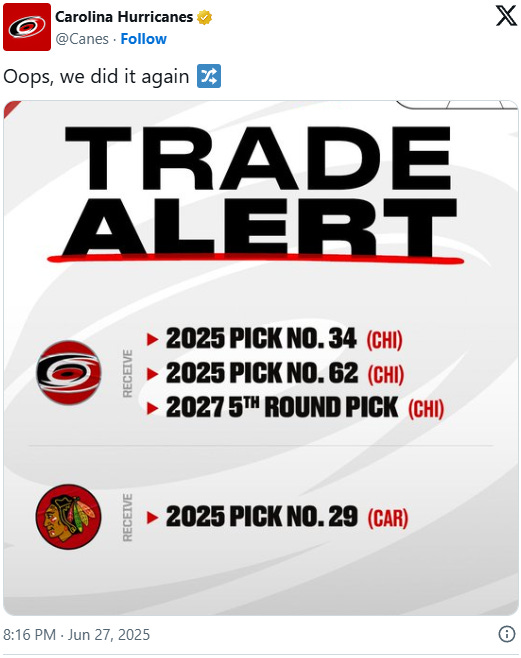
This is a deliberate long-term strategy that the Hurricanes employ, and it’s worth stepping back from the immediate trade to look at the long-term process. In the six-year span from 2012 to 2018, Carolina made just one picks-for-picks trade at the draft. In the six-year span from 2019 to 2025, they’ve done it 14 times, with rounds 2-7 still to go in 2025. It’s a change in approach likely driven by two personnel changes: the replacement of Ron Francis by Don Waddell as general manager, and the promotion of Eric Tulsky to a directorship and then a vice presidency (and ultimately further).
The Hurricanes have a two-part strategy they employ in these trades:
· Moving down to add extra picks
· Trading a depth pick in the current year for a presumably higher one the following year
I wanted to visualize the results of this approach, so I threw a quick graph together. Red picks are selections acquired by Carolina with this approach; white picks are the ones traded away.
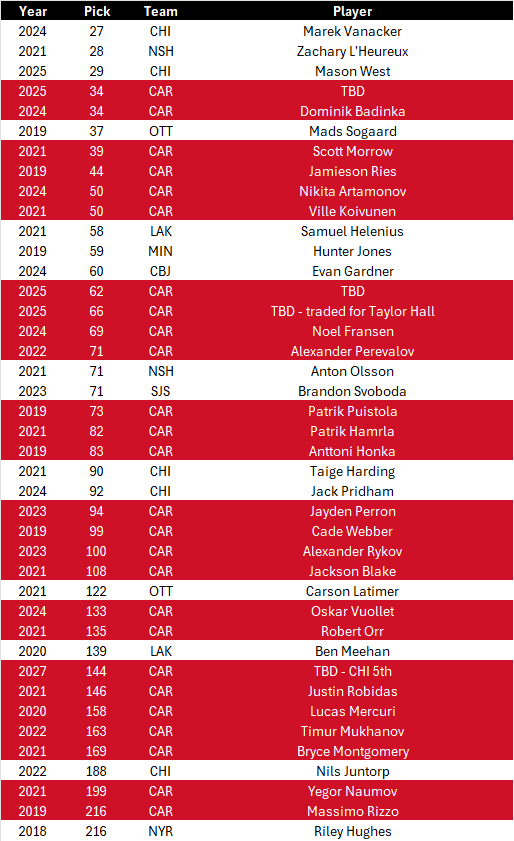
We’ll get into player valuation in a moment here, but let’s start by looking at what this strategy has done to pick count and pick location.
First: Carolina turned a total of 15 picks over these drafts into 26 total selections. That’s not quite a doubling effect, but it’s awfully close. The value of this to a contender should be obvious, since most NHL contenders don’t have enough prospects and don’t have enough draft picks and eventually run out of both steam and the ability to maneuver in trades.
If we look at the value of the four best picks Carolina has given up, we see they’ve moved from an average draft position at 30th overall down to an average draft position at 38th overall. That’s eight spots, at a point where draft boards begin to diverge anyway. I’d love to see their internal lists, but my guess is that most of the time they’re able to take the player they would have taken anyway. They’ve also gone from having seven picks in the first two rounds… to having seven picks in the first two rounds.
In exchange for those marginal concessions, the Hurricanes have added 11 extra picks in rounds three through seven.
In a lot of these cases, it’s still too early to determine ultimate player value, so I won’t make any grandiose proclamations here. What I will say is that I like the way things are trending for Carolina.
The most accomplished NHL player on the list so far is Jackson Blake, who was selected with the throw-in pick so Los Angeles could move up from 71st overall in 2021 to 58th (Carolina subsequently flipped the No. 71 pick for two other selections – one of which, Justin Robidas, played his first NHL hockey this season).
Of the early prospects, Zachary L’Heureux is probably the most notable name traded away. He looks like he’s going to be a real player. On the other hand, so does the player Carolina got with the pick that came back in that trade, Scott Morrow. I like both players, but Morrow’s profile (big, offensive right-shot defenceman) carries more value than L’Heureux’s (undersized agitating winger).
The Hurricanes have also been able to use a lot of these players as trade chips in major-league deals. Ville Koivunen, who has seven points in his first eight NHL games, was in the system to be traded in the Jake Guentzel package because of this trade-down strategy. Ditto for the 2025 third-rounder that figured into the Mikko Rantanen/Taylor Hall deal.
There’s another trade angle here, too: Carolina likes to aggressively cut bait with prospects who are trending towards being AHL/NHL fringe players, turning them into more draft picks. That’s beyond the scope of this write-up, but worth mentioning, because turning a high-certainty/low-upside piece into a low-certainty/high-upside piece is another move that’s generally worth making. Fringe/system guys are always available at no asset cost in free agency.
What I don’t understand is why more teams don’t pursue this overarching approach. All it really takes is a ruthless willingness to look at the big picture rather than getting fixated on an internal draft board that may or may not be better than anyone else’s. The upside is a nearly bottomless supply of additional picks and prospects – something every contender needs, but only Carolina actually seems to have.